
 21 hours ago
1
21 hours ago
1
ARTICLE AD BOX
WASHINGTON — As his “four-to-five” week war against Iran is halfway through its eighth week, President Donald Trump is now complaining that polls reflecting the war’s consistent unpopularity are “rigged” while seeming confused about peace talks that appear to be, at best, recreating a deal with Iran he ripped up during his first term.
The two-week ceasefire Trump announced April 7 is set to expire Tuesday, with negotiations to permanently end the fighting now reportedly including terms reminiscent of a 2015 agreement limiting Iran’s nuclear program negotiated by President Barack Obama’s administration. Trump tore up the deal in 2018, and a return to that framework has Obama alums wondering what, exactly, was the point in abandoning it in the first place.
“Exactly,” said Jim Townsend, a former deputy assistant secretary of defense in the Obama administration. “And how many people had to die to gain what we already had?”
Thirteen U.S. service members have died in Trump’s war, with hundreds more injured. At least 1,500 Iranian civilians have been killed.
Robert Kagan, a top State Department official in Ronald Reagan’s administration, said Trump has actually blundered into a far worse situation, making Iran stronger than it has ever been.
“Taking what had been an entirely open Strait of Hormuz, recognized as an international waterway enjoying freedom of navigation, and placing it in Iran’s control going forward,” he said. “Any deal that leaves Iran in effective control of the strait is a strategic disaster, but that is almost certainly where we are headed. This will turn Iran into a major global power for the foreseeable future.”
One big reason Trump is stuck trying to recreate a deal he once disdained is that the intervening eight years gave Iran a chance to acquire a new and valuable bargaining chip: a significant quantity of highly enriched uranium, which it began to produce after Trump pulled out of the nuclear deal.
Iran had been abiding by the terms of the agreement, which included allowing inspectors at its nuclear facilities. Some in Trump’s own administration, such as early national security adviser H.R. McMaster, had advised him not to abandon the deal because it was working.
“This war has been disastrous, and the U.S. would have been in a better position had Trump never walked out of the JCPOA,” said Trita Parsi, an Iran analyst with the anti-interventionist Quincy Institute, using the Iran deal’s formal name, the Joint Comprehensive Plan of Action.
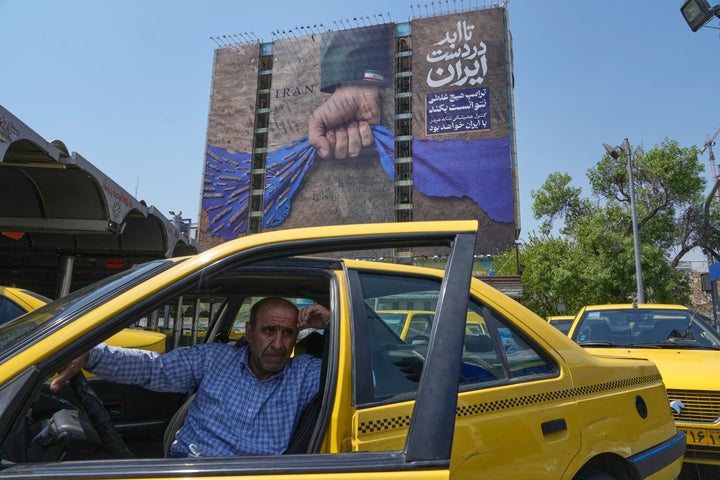
AP Photo/Vahid Salemi
Trump himself seemed to realize that a new agreement that again imposes a moratorium on nuclear enrichment in return for a lifting of some or all of the economic sanctions currently imposed on Iran would call attention to his many years of attacking the previous deal.
“The DEAL that we are making with Iran will be FAR BETTER than the JCPOA, commonly referred to as ‘The Iran Nuclear Deal,’ penned by Barack Hussein Obama and Sleepy Joe Biden, one of the Worst Deals ever made having to do with the Security of our Country,” Trump wrote early Monday afternoon.
Trump then went on to repeat his familiar lie that the agreement would have given Iran a nuclear weapon. In fact, it limited Iran’s ability to enrich uranium to a level far below what is necessary to make atomic weapons.
Under the agreement, Obama unfroze some Iranian assets in U.S. banks — money that the U.S. was likely going to have to turn over regardless due to a lawsuit. In contrast, Iran has made many more billions of dollars because of higher oil prices thanks to the war, and any new agreement with Iran would almost certainly provide it with far more money than it received under Obama.
“We should all hope he strikes a good deal, while recognizing it will just be a different flavor of the one he ripped up eight years ago, which freed the Iranians to renew their program,” said David Axelrod, a former top aide to Obama. “I’ve always felt the principal motivation for ripping up the JCPOA was that it was an Obama achievement. Like the Affordable Care Act, Trump has a pathological desire to rip up anything associated with Obama’s legacy.”
Trump, meanwhile, on Monday continued offering up mixed messages on social media and in brief phone interviews with reporters that suggest he is having difficulty keeping track of events.
After complaining in a 10:16 a.m. social media post that polls showing his war is becoming even more unpopular are “rigged” and repeating his lie that the 2020 election had been stolen from him, Trump then told the New York Post that Vice President JD Vance was on his way to Pakistan for a second round of talks with Iran. “They’ll be there tonight, [Islamabad] time,” Trump said.
However, Vance was not even close to leaving Washington at that point and shortly thereafter turned up at the White House.
Soon afterward, Trump told Bloomberg News that the current ceasefire with Iran ends “Wednesday evening Washington time,” and that he likely will not extend it. “I’m not going to be rushed into making a bad deal. We’ve got all the time in the world,” he said.
Trump announced a “two-week” ceasefire on April 7 at 6:32 p.m. Eastern time. Two weeks from that moment is 6:32 p.m. Tuesday. It is unclear why he is now saying the two-week window ends on Wednesday.
The phone calls with reporters appear to have become his favorite format for press interactions in recent weeks, possibly because they allow little opportunity for follow-up questions and each is promoted as an “exclusive” interview by the media outlet in question.
As he has from within days of the start of the attacks on Feb. 28, Trump continues claiming he has “won” because Iran’s air force and navy have been destroyed and most of its leadership killed and replaced. He is also now claiming that constitutes “regime change,” even though the same government continues to be in charge.
“If Iran’s new leaders (Regime Change!) are smart, Iran can have a great and prosperous future!” Trump wrote.






 English (US) ·