
 14 hours ago
1
14 hours ago
1
ARTICLE AD BOX
The job of vice president is often a thankless one. John Nance Garner, President Franklin Roosevelt’s first vice president, called it “a no man’s land somewhere between the legislative and executive branch,” and reportedly once told Lyndon Johnson, a future vice president, that the office “isn’t worth a pitcher of warm spit.”
That’s something that Vice President JD Vance may have learned over the weekend ― although the circumstances are a bit different than in Gardner’s day.
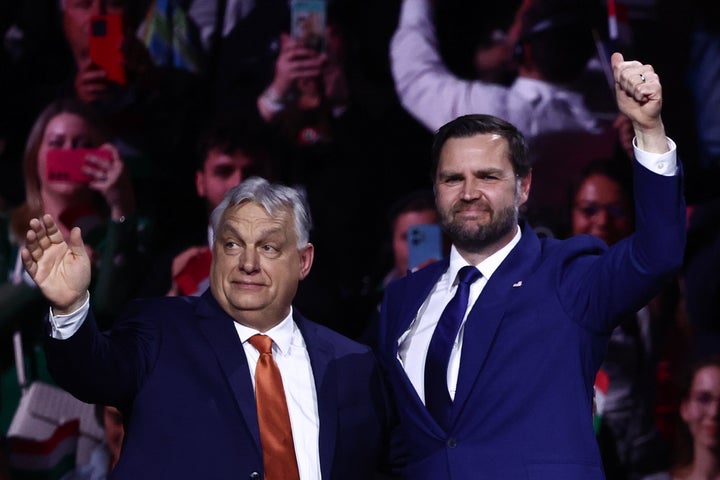
Over the past week, Vance embarked on his most important foreign policy missions yet. President Donald Trump sent Vance, his most likely successor in 2028, to Hungary to campaign for the besieged autocrat Viktor Orban as he struggled for the first time in the polls in 16 years ahead of Sunday’s election. And then, Vance led the U.S. delegation to negotiate a permanent ceasefire agreement with Iran in Pakistan.
These were two of the most important priorities of the Trump administration and the larger far-right populist movement that it represents. And they both flamed out, rather spectacularly.
Orban lost on Sunday to an opposition coalition led by Peter Magyar, a former member of Orban’s party who defected in reaction to the regime’s corruption and proud illiberalism. Magyar’s coalition didn’t just beat Orban’s Fidesz party, it won a crushing victory with a supermajority of legislative seats capable of repealing Orban’s illiberal constitutional changes.
In Pakistan, during negotiations over Trump’s war of choice against Iran — which has deeply undermined his core political pitch that America should put American interests first — the U.S. proved unable to assert its national interests. After less than 24 hours of negotiation, the Vance-led team seemingly walked away from the table having reached no deal.
It could be said that the advance of a global right-wing populist movement, the kind that Trump hints to as a mandate for his own administration, hinged on these two events. And Vance, put forward as the American face for them, promptly face-planted.
Jakub Porzycki/NurPhoto via Getty Images
Trump’s second term is modeled on Orban’s autocratic rule. The Trumpist right has long looked to Orban’s Hungary for what they should do to consolidate power: defund universities, gerrymander legislative districts, fix election rules and take over the media. The Heritage Foundation even partnered with Orban’s Danube Institute to help write the Project 2025 roadmap for Trump’s second term.
“There is an alternative” to the American and European models of government, Vance said on April 8, “and it’s right here in Hungary.”
The war in Iran, meanwhile, greatly threatens the whole right-wing project. This war of choice not only undermined the Trumpian idea that the United States not get bogged down in foreign quagmires, it also threatens every American’s ― and everyone in the world’s ― economic well-being. Six weeks of war have already caused inflation to spike while the full ripple effects of the closure of the Strait of Hormuz have yet not been fully felt. If Trump has any hope of matching Orban’s 16 years of success in instituting a competitive authoritarian regime, he needs to protect his party from heavy losses in the 2026 midterms. It doesn’t help when he causes economic pain for everyone.
But Trump has reportedly gotten tired of the war he started and has been looking for off-ramps.
“[Trump] is getting a little bored with Iran,” a White House official told MSNOW. “Not that he regrets it or something — he’s just bored and wants to move on.”
That means someone else has to step in and clean up the mess. And that person is Vance, who has hitched himself to a massive loss for right-wing populists and, despite reports that he was opposed to the War in Iran, is left holding the bag for the war’s potentially catastrophic economic impacts as the face of the failed negotiations.
As Vance, who has no diplomatic or foreign policy experience, announced that Iran has “chosen not to accept our terms,” which he characterized as “our final and best offer,” Trump sat octagon-side at a UFC cage match with Secretary of State Marco Rubio. Oil futures jumped back above $100 after falling to the low-90s after the April 7 announcement of a 10-day ceasefire.
Mohammad Javad Zarif, the former Iranian foreign minister who reached the 2015 nuclear deal with the Obama administration that Trump tore up, pointed to Vance’s words as the exact reason why Iran could not trust the U.S. position.
“No negotiations – at least with Iran – will succeed based on ‘our/your terms,’” Zarif posted on social media. “The US must learn: you can’t dictate terms to Iran.”
There were other signs this weekend that Vance’s political clout is under strain. Vance, who has spoken often and publicly about his Catholic faith (he has an upcoming memoir about his conversion), has been conspicuously silent since Trump attempted to pick a fight with Pope Leo XIV on social media on Sunday.
Vance’s inability to smooth the way with the pontiff has been a point of embarrassment before. Earlier this year, the American-born Leo apparently declined an invitation, delivered by Vance, to visit the United States for the nation’s 250th anniversary. The Vatican announced he will instead visit a Mediterranean site known for migrant crossings. And Leo’s predecessor, Pope Francis, actively condemned Vance’s religious-tinged political rhetoric around migrants in a 2025 letter to U.S. bishops. Vance was one of the last official visitors to Francis before he died in April 2025.
Trump’s Truth Social tirade against Leo was, ironically, over the pope’s criticisms of the war with Iran. Now, with the Vance-led peace talks stalled and the vice president apparently unable to soften the blow as his boss escalates a new feud with the Vatican, it seems to leave Vance 0/3 on attempts to influence the world stage.
Vance’s forays into foreign affairs are representative of how the modern vice presidency has changed from when Garner called it a no man’s land. The office has become either a power of its own, as when more seasoned political veterans like Dick Cheney and Joe Biden occupied the office, or, more frequently, a stepping stone for a successor, as with vice presidents Al Gore and Kamala Harris. (Perhaps Mike Pence would be included here if he had the courage.)
And Vance clearly sees himself as the heir to Trump’s Republican Party ahead of 2028. But he seems to have been set up to fail. His assignments are beginning to look like President Joe Biden’s decision to put Harris in charge of diplomacy to stem migration from Central America in 2021 ― a thankless job on an issue that wasn’t working for Democrats at the time.
It may well turn out that Vance’s vice presidency ― thanks to the new added responsibilities ― is still not worth a pitcher of warm spit.
Related
j.d. vanceIran war hungary



 English (US) ·