
 (6).png) 2 hours ago
1
2 hours ago
1
ARTICLE AD BOX
The Strait of Hormuz is vital to global oil shipments, and any blockade could cause sharp price increases. On 13 April, the Speaker of Iran's Parliament shared a screenshot of current petrol prices at Washington DC fuel stations.
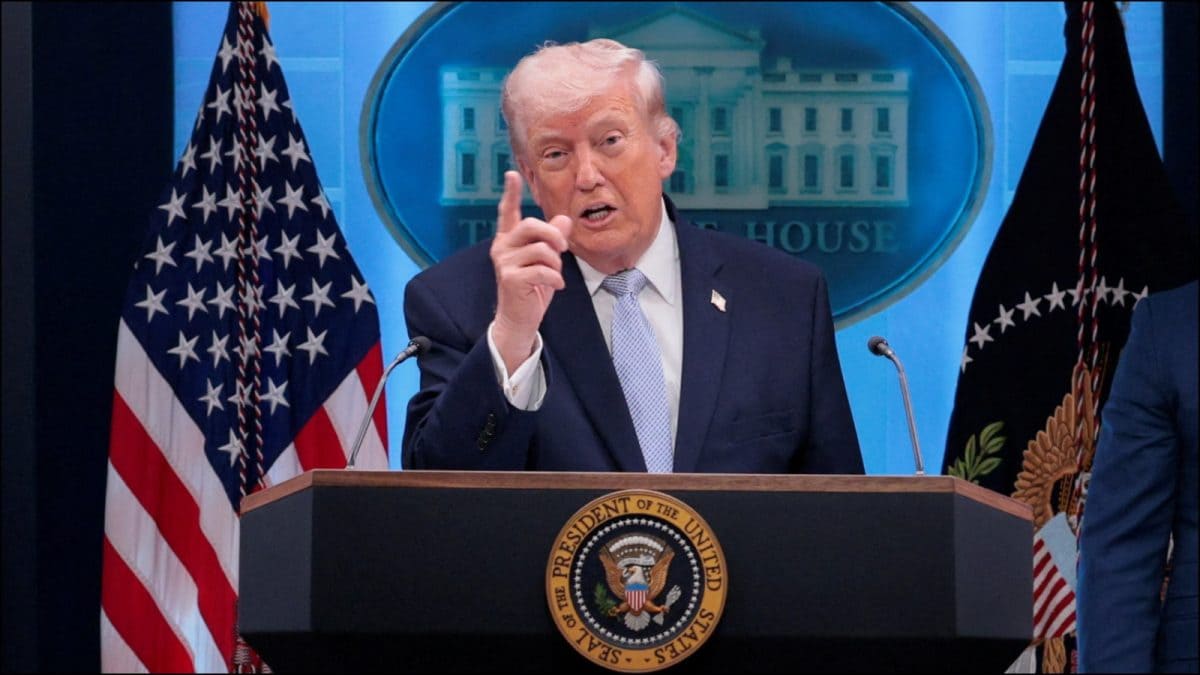
 Iran taunts US over Strait of Hormuz, fuel prices: Social media reacts to viral post, ‘Americans would survive…’ (AP Photo/Julia Demaree Nikhinson)(AP Photo/Julia Demaree Nikhinson)
On 13 April, Mohammad-Bagher Ghalibaf shared a screenshot of current petrol prices at Washington DC fuel stations near the White House. The social media post was a direct taunt at America.
The Speaker of Iran's Parliament hinted that a blockade of the Strait of Hormuz would make these prices look cheap in the near future. “Enjoy the current pump figures. With the so-called 'blockade', soon you'll be nostalgic for $4–$5 gas,” he wrote.
The post went viral quickly, reaching 20 lakh views in just 7 hours. The ‘equation’ in the post has grabbed attention. Since we were equally clueless, we asked Grok to explain the mathematical-looking formula.
According to the AI assistant, it’s not a standard formula from any economics or mathematics textbook. It is pseudo-mathematical notation, a dressed-up symbolism meant to sound sophisticated or go viral as a meme.
The intent is to say that oil price disruptions are nonlinear. According to the pseudo-mathematical formula, oil prices spiral upward much faster than a straight-line calculation would suggest.
The reasons include second-order effects such as panic buying, supply chain disruptions, tanker rerouting, and market speculation. All these reasons pile on top of the original supply shock.
The blockade of the Strait of Hormuz means the change is greater than zero if even a small amount of oil supply is choked off.
The made-up ‘price impact’ function. Applying it twice, once for the initial shock, then again for second-order effects, produces a much worse outcome than applying it only once.
In plain language, if Iran blocks the strait even a little, fuel prices will not just rise, they will compound rapidly. The $4–$5-per-gallon prices shown in the Google Maps screenshot will soon seem like the "good old days".
Strait of Hormuz
At the same time, Iran’s claim is not entirely baseless. The Strait of Hormuz is a critical chokepoint for around 20% of global oil shipments. Any sustained blockade would likely cause sharp, nonlinear price spikes.
However, any such move by Iran would also invite a strong and swift military response from the United States and its Gulf allies. That would quickly change the situation on the ground.
India imports a substantial portion of its crude oil from the Gulf region. Any disruption in the Strait of Hormuz would directly impact Indian fuel prices and energy security.
The Indian rupee would also face pressure if global oil prices spike sharply. Indian policymakers and the petroleum ministry will be watching these developments closely.
Social media reaction
Critics in the replies called it "fake math". Many social media users have also pointed out the irony. Iran's own economy has suffered far more severely from oil-related sanctions and disruptions than the US has.
“Bro, the average salary in Iran is 100 dollars today, and a kg of beef costs 15 dollars there. Worry about that. Pretty sure Americans would survive $2 price-hike where 10% of its people are millionaires,” wrote one of them.
“By closing the internet and the Strait of Hormuz, the Islamic Republic thinks it can hold Iranians and the world economy hostage. Instead, the resulting unemployment, inflation, and tsunami of protests will soon destroy the last remnants of Khamenei’s regime,” posted another user.
Another user wrote, “The regime that can’t keep its generals alive is worried about American gas prices…”
“How about I stop driving? I have other options. You, however, go and start farming sand, because without oil, you have nothing!” came from another.
About the Author
Sounak Mukhopadhyay
Sounak Mukhopadhyay covers trending news, sports and entertainment for LiveMint. His reporting focuses on fast-moving stories, box office performance, digital culture and major cricket developments. He combines real-time updates with clear context for everyday readers. <br><br> Sounak brings newsroom experience across breaking news, explainers and long-form features. He has a strong emphasis on accuracy, verification and responsible storytelling. His work tracks audience behaviour, celebrity influence and the business of sport and cinema. He helps readers understand why a story matters beyond the headline. <br><br> Sounak has contributed to widely read digital publications. He continues to build a body of journalism shaped by consistency, speed and editorial clarity. He is particularly interested in the intersection of media, popular culture and public conversation in contemporary India. <br><br> At LiveMint, he writes daily coverage as well as analytical pieces that interpret numbers, trends and cultural moments in accessible language. His approach prioritises factual depth, balanced framing and reader trust. The reporting aligns with modern newsroom standards of transparency and credibility. <br><br> Outside daily reporting, he explores storytelling across formats including podcasts, filmmaking and narrative non-fiction. Through his journalism, Sounak aims to document the rhythms of modern entertainment and sports while maintaining rigorous editorial integrity. <br><br> Sounak continues to develop audience-focused journalism that connects speed with substance in a rapidly-changing information environment. His work seeks clarity, trust and lasting public value in every story he reports.




 English (US) ·