
 1 hour ago
1
1 hour ago
1
ARTICLE AD BOX
Last Updated:February 28, 2026, 15:13 IST
Israel-Iran war: Though roughly equal in the number of troops, the two militaries bring strikingly different tactics and firepower. Here's how they stack up in comparison


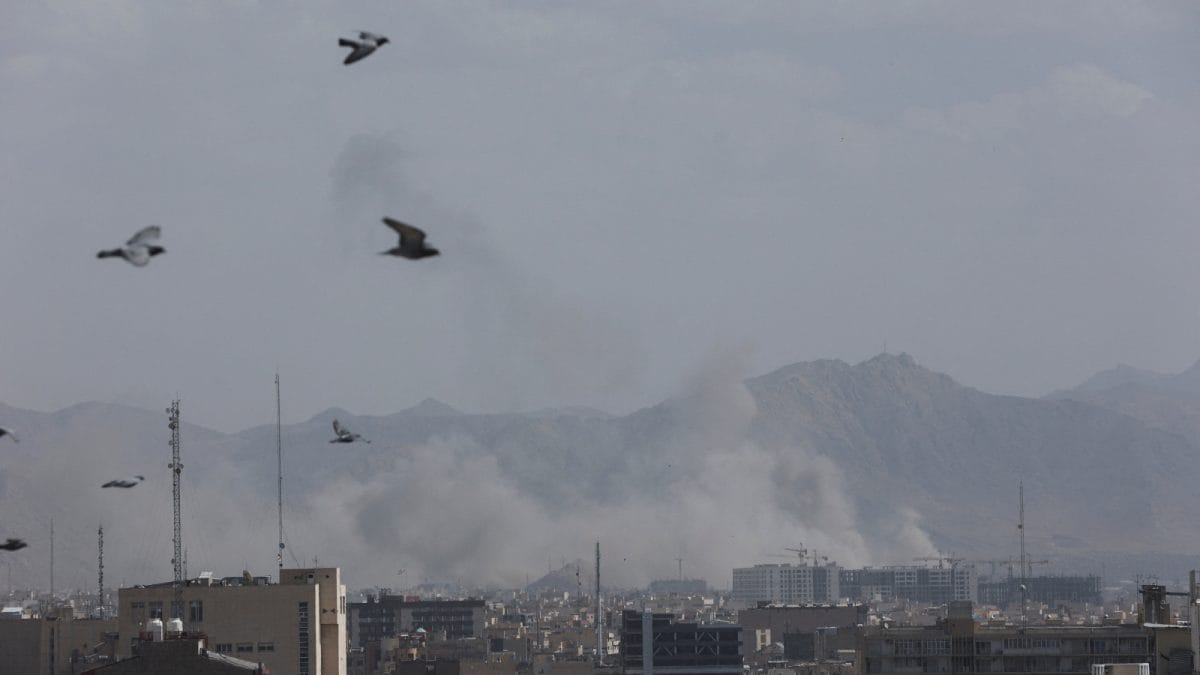
Israeli-US strikes against Iran have plunged the Middle East into a renewed military confrontation, further dimming hopes for a diplomatic solution to Tehran's nuclear dispute with the West. (AP)
Israel launched a pre-emptive attack against Iran on Saturday, and a United States attack is underway, plunging the Middle East into a renewed military confrontation and further dimming hopes for a diplomatic solution to Tehran’s nuclear dispute with the West.
The attack follows a 12-day air war in June between Israel and Iran and repeated US-Israeli warnings that they would strike again if Iran pressed ahead with its nuclear and ballistic missile programmes.
So how do the militaries of Iran and Israel stack up against each other?
Iran boasts a large standing force but also relies on proxies and undercover operations that have been severely disabled in recent years by US and Israeli actions. Israel, meanwhile, relies on both subterfuge and robust regular ground and air forces that are apparently unmatched in the region. Though roughly equal in the number of troops, the two militaries bring strikingly different tactics and firepower.
Where does Iran stand?
According to an Associated Press report from June 2025, on paper, Iran would seem to have an advantage in numbers, with 88 million people and a land area of 1.6 million square kilometers compared to Israel’s 9 million people and 22,000 square kilometers. Militarily however, those numbers mean little.
Iran’s troops are divided between the regular armed forces, generally commissioned with guarding Iran’s borders and carrying out more conventional military tasks, and the paramilitary Revolutionary Guard, including the elite Quds Force, the strategic missile command and the cyberforce.
The regular forces command the bulk of the troops — around 600,000 men — and standard equipment, while the Revolutionary Guard has about 200,000 personnel split between various divisions. Along with Iran’s proxies, its conventional forces are believed to have been heavily degraded by Israeli and US military operations since 2024.
Iran’s military equipment is a hodge-podge, including some provided by the Soviet Union and others by the US prior to the 1979 Islamic Revolution, along with more recent Russian additions.
With an estimated 350 antiquated planes in its air force, it lags far behind Israel in both quantity and quality. Iran, however, does have the ability to produce a wide range of UAV’s and similar equipment, typified by the Shahed attack drones it has sold to Russia in large numbers for use in the war in Ukraine.
Iran claims to possess a multi-warhead missile, known as the Khorramshahr, which was first tested in 2017 and appears likely to be derived from a North Korean missile, according to a report by the Center for Strategic and International Studies’ Missile Defense Project.
According to the CSIS report, “the ‘multiple warheads’ claim is most likely a reference to a submunitions warhead, rather than multiple independently targetable reentry vehicle (MIRV) technology." A true MIRV missile allows separately targeted warheads to be set on independent paths from the main missile.
Iran’s nuclear program has advanced in recent years, and it is believed to have developed enough uranium enriched to near-weapons grade levels to produce multiple nuclear weapons in a matter of months if it took the decision to do so.
But Iran would need even more time to develop a missile or other means of weaponising them. Israel does not appear inclined to take that chance, however, having already struck facilities manufacturing nuclear material and ballistic missiles in 2025.
How does Israel compare?
Israel’s formidable land, sea and air forces are derived from both the latest US and European technology as well as a robust domestic defence industry that can design, build and sustain a full range of armaments, allowing it to take on opponents on multiple fronts at the same time.
For a small nation it also has a considerable supply of troops, with about 170,000 active duty forces and another 400,000 reserves. Though fewer than Iran, Israel’s forces have been battle hardened by regional conflicts.
Israel has built a multi-layered air defence shield to counter threats ranging from long-range ballistic missiles to short-range rockets and drones. At the top tier is the Arrow system — including Arrow-2 and Arrow-3 — designed to intercept long-range ballistic missiles inside and outside the atmosphere.
Developed primarily by Israel Aerospace Industries with US involvement from Boeing, it is engineered to neutralise threats at high altitudes, allowing safe dispersal of non-conventional warheads. Supporting it at mid-range is David’s Sling, built jointly by Rafael Advanced Defense Systems and US-based RTX Corp, which can intercept ballistic missiles, aircraft, drones and cruise missiles fired from roughly 100–200 km away.
For shorter-range threats, Israel deploys the widely known Iron Dome, operational since 2011 and developed with US backing. It uses radar-guided interceptors to destroy rockets, mortars and drones mid-air, while selectively ignoring projectiles that are not headed toward populated areas.
Originally designed to counter rockets with ranges of 4-70 km, its capabilities have since expanded. A naval variant protects ships and offshore assets. Complementing it is the newly operational Iron Beam, a ground-based laser system declared fully active in late 2025, which uses high-powered lasers to disable smaller aerial threats at a significantly lower cost per interception.
In addition to its domestic systems, Israel has been reinforced by the US-deployed THAAD (Terminal High Altitude Area Defense) system, capable of intercepting short-, medium- and intermediate-range ballistic missiles in their final flight phase. The US military has assisted in intercepting Iranian missiles using both ground systems and naval assets in the Mediterranean. Israeli fighter jets and combat helicopters also contribute to air defence by using air-to-air missiles to destroy incoming drones, adding another layer to the country’s defensive umbrella.
Israel is widely believed to be the only nuclear-armed state in the Middle East, though it has never acknowledged having such weapons. Israel also has a steadfast ally in the United States, which has been key in previous conflicts and will likely be crucial in any that follow.
With inputs from Associated Press
First Published:
February 28, 2026, 15:13 IST
News world Israel-Iran War: Whose Military Has The Upper Hand?
Disclaimer: Comments reflect users’ views, not News18’s. Please keep discussions respectful and constructive. Abusive, defamatory, or illegal comments will be removed. News18 may disable any comment at its discretion. By posting, you agree to our Terms of Use and Privacy Policy.
Read More






 English (US) ·