
 6 hours ago
1
6 hours ago
1
ARTICLE AD BOX
Last Updated:April 14, 2026, 12:45 IST
Spanish PM Sanchez visits China to seek better market access and tech investment, as US blocks the Strait of Hormuz and China vows its ships will keep sailing


Spanish Prime Minister Pedro Sanchez offers a speech at the University of Chinese Academy of Sciences in Beijing, China, 13 April, 2026. (Image Courtesy: Andres Martinez/Reuters)
New Delhi/Beijing/Madrid: Spanish Prime Minister Pedro Sanchez arrived in Beijing on Saturday for a five-day official state visit, his fourth trip to China in four years, to push for greater Chinese market access, sign a technology investment deal, and address a growing bilateral trade deficit, as US-Iran ceasefire talks collapsed in Islamabad after 21 hours and the US Navy began enforcing a blockade of vessels entering or leaving the Strait of Hormuz. By Monday morning, China’s Defence Minister Admiral Dong Jun had already warned Washington that its ships would keep sailing regardless.
Europe does not announce its realignments. They happen in the accumulation of flights, of trade frameworks signed in Beijing rather than Washington, of telephone calls not made to the White House. Sanchez’s four visits in four years, the last of which carries the diplomatic status of an official state visit for the first time, are that accumulation made visible.
He addressed students at Tsinghua University on Monday as he began his formal agenda and said: “We need China to open up so that Europe does not have to close itself off, and to help us correct the current trade deficit we have with it." He described Europe’s unity as “a guarantee of stability and prosperity in the world, a world that cannot be understood without China," and told the room that multipolarity “is not a hypothesis or a wish. It is the new reality in which the world lives."
The Numbers In The Ledger
The deficit Sanchez was describing is not rhetorical scaffolding. According to Eurostat, the EU exported €199.6 billion worth of goods to China in 2025 and imported €559.4 billion, producing a trade deficit of €359.8 billion. Compared with 2024, exports fell by 6.5 per cent while imports rose by 6.4 per cent. Sanchez told the Tsinghua audience the imbalance had grown 18 per cent in 2025 alone. For Spain specifically, the bilateral deficit with China sits at approximately €40 billion.
Some of the acceleration traces directly to Washington. After the United States imposed tariffs of up to 145 per cent on Chinese goods in April 2025, Beijing redirected exports that could no longer reach the American market toward Europe, where Chinese goods still face duties of just two to three per cent under WTO rules. Since 2015, EU imports from China have grown by 89 per cent, while EU exports to China grew by 37.1 per cent over the same period. Europe is, in practice, absorbing the overflow of a trade war it had no hand in starting.
Spain and China plan to sign a High-Quality Investment Agreement during the visit, which aims to ensure Chinese investments in Spain involve technology transfers to domestic companies, contracts for local suppliers, and job creation in the regions where they operate. The Spanish delegation also includes meetings with investors and with Spanish companies operating in China, among them biopharmaceutical firm Grifols and solar energy company MASPV.
The Queue For Beijing
Spain is not the outlier here. British, Canadian, and German leaders have all made their own trips to Beijing in recent months as Trump’s tariffs and unpredictable foreign policy have caused concern across the Western alliance. Sanchez has leaned hard into the role of Europe’s most direct voice on this. His government denied Spain’s military bases for use in US strikes against Iran. His last Beijing visit drew a rebuke from US Treasury Secretary Scott Bessent, who warned Spain against “cutting your own throat." Sanchez booked the next flight.
At Tsinghua, he went further than trade. He urged China to play a larger role in fighting climate change, promoting global health, and controlling the development of artificial intelligence and nuclear weapons. He called for Western nations to cede some of their representation at international institutions. “This new multilateral order must work," he said, “and it must do so with balanced and reciprocal trade relations." Chinese foreign ministry spokeswoman Mao Ning called Spain “an important partner of China within the EU," adding that the visit offered a chance to “promote bilateral relations to an even higher level."
At The Strait
On Sunday, Trump announced via social media that the US Navy would begin blocking all ships entering or leaving the Strait of Hormuz, after peace talks with Iran in Islamabad ended without an agreement. Tanker traffic through the strait, which had begun to recover after a two-week ceasefire, came to a halt again within hours.
China’s response came the same day. Admiral Dong Jun said: “Our ships are moving in and out of the waters of the Strait of Hormuz. We have trade and energy agreements with Iran. We will respect and honour them and expect others not to meddle in our affairs. Iran controls the Strait of Hormuz, and it is open for us." China buys 80 per cent of Iran’s oil and already pays Tehran in yuan.
Trita Parsi of the Quincy Institute warned in an interaction with CNBC that oil could reach $150 per barrel under a full blockade, and the head of the International Energy Agency called the current disruption the worst energy shock in history. Former US Air Force colonel Cedric Leighton warned that a direct encounter between a Chinese tanker and the US Navy carried “major escalation" risk, with rules of engagement still unclear.
Britain has said it will not join the blockade. Australia has called for the strait’s immediate full reopening. The Secretary-General of the International Maritime Organization stated that under international law, no country has the right to blockade an international strait used for international transit.
Never Interrupt Your Enemy When He Is Making a Mistake
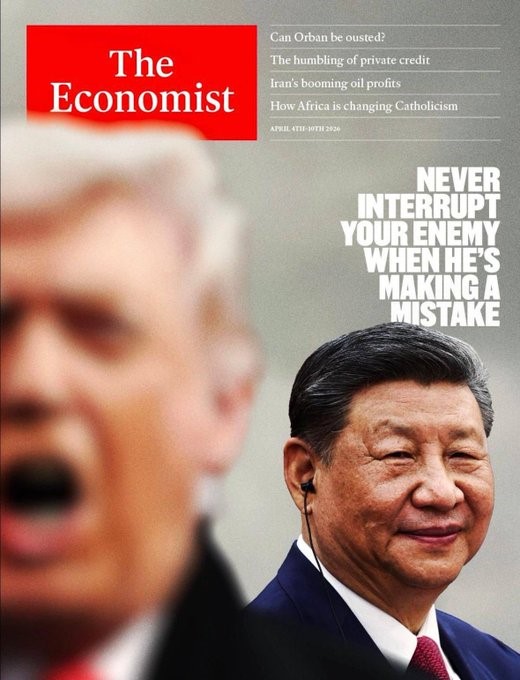
The cover of this week’s Economist shows Donald Trump blurred in the foreground, relegated to soft focus, with Xi Jinping behind him in sharp relief, smiling. The quote is Napoleon’s.
The United States emerged from the Cold War as the world’s single dominant power and spent the decade that followed largely unchallenged. China’s rise over the two decades after that returned the international system toward two poles. What is visible now, in the margins of a Spanish prime minister’s fourth Beijing visit and a Chinese admiral’s statement about shipping lanes, is the early articulation of something beyond two.
Sanchez called it the beginning of the multipolar world.
With European leaders in Beijing, the US Navy at Hormuz and China telling Washington to stay out of its business, it is difficult to argue that he is wrong.
Handpicked stories, in your inbox
A newsletter with the best of our journalism
First Published:
April 14, 2026, 12:45 IST
News world Prime Minister Sanchez's Fourth Beijing Visit In Three Years And The Making Of A New World Order
Disclaimer: Comments reflect users’ views, not News18’s. Please keep discussions respectful and constructive. Abusive, defamatory, or illegal comments will be removed. News18 may disable any comment at its discretion. By posting, you agree to our Terms of Use and Privacy Policy.
Read More




 English (US) ·