
 2 hours ago
1
2 hours ago
1
ARTICLE AD BOX
Last Updated:January 22, 2026, 14:00 IST
About €300 billion of Russian assets remain frozen abroad, dominated by Europe’s holdings, with the United States controlling only a minimal fraction.

US President Donald Trump and Russian President Vladimir Putin. (IMAGE: REUTERS FILE)
The question of Russia’s frozen assets has gained renewed attention after President Vladimir Putin said Moscow was prepared to contribute $1 billion from funds frozen in the United States to US President Donald Trump’s proposed Board of Peace.
Putin made the remarks during a televised meeting of Russia’s Security Council late Wednesday, ahead of talks with American envoys expected to arrive in Moscow to discuss a possible settlement of the Ukraine conflict. “I think that we could contribute one billion dollars to the Board of Peace from the frozen assets," Putin said, adding that the issue would be discussed with Palestinian President Mahmoud Abbas.
“Incidentally, the remaining funds from our frozen assets in the United States could be used to rebuild territories damaged by the fighting after a peace treaty is concluded between Russia and Ukraine," he added.
Putin’s offer has drawn focus back to the underlying numbers: how much Russian money is actually frozen abroad, and where is it held?
Since the invasion of Ukraine in 2022, Western sanctions have immobilised a vast pool of Russian sovereign reserves overseas — close to €300 billion. But this money is not distributed evenly. Europe controls almost the entire stock, while the United States holds only a small fraction.
What Are Frozen Russian Assets And Why Were They Seized?
Frozen assets are financial funds or property that their owners cannot access or transfer because of restrictions imposed by a government or regional bloc. In Russia’s case, the freezes apply both to sovereign assets — cash, bonds and securities held abroad — and to private property such as yachts and real estate owned by sanctioned individuals.
According to DW, the freezes are implemented by financial institutions, including commercial banks and central securities depositories, which must block transactions.
These measures were imposed after the 2022 invasion of Ukraine to limit Moscow’s access to foreign reserves and restrict its ability to finance the war. They also reflect a coordinated mechanism in which Western states immobilise assets held within their jurisdictions while preventing their repatriation.
How Much Russian Money Is Frozen Worldwide?
Between €289 billion and €300 billion in Russian assets have been frozen worldwide since the 2022 invasion. Using the updated exchange rate of €1 = $1.1687 (22 January 2026), this corresponds to roughly $338 billion to $350 billion today.
This pool of frozen assets includes both sovereign holdings and private assets, but is dominated by funds belonging to the Russian central bank.
How Much Does Europe Hold?
Europe’s financial system carries the heaviest share of Russia’s frozen reserves. Roughly €209 billion to €210 billion is held under EU jurisdiction, an overwhelming majority of the global total. At today’s valuation, that corresponds to $244 billion to $245 billion.
The single largest concentration of Russian assets sits in Belgium, where Euroclear, one of the world’s most significant securities depositories, handles cross-border transactions for trillions of euros in financial instruments. Around €180 billion of Russia’s immobilised reserves are parked within Euroclear’s ecosystem.
A striking portion of that amount, close to €176 billion, now exists as cash balances rather than active securities. This happens when bonds mature or pay out, but the proceeds cannot be moved to their rightful owner. Instead, they accumulate inside the system, creating large, idle cash positions.
Euroclear’s pivotal role has also placed it under legal and political pressure. Moscow has initiated a €230 billion lawsuit claiming not only the frozen assets but also the interest it argues should have accrued to Russia during the freeze.
EU Locked The Principal ‘Indefinitely’
While the EU has decided not to touch the principal amount, it does use the windfall profits generated while the assets sit immobilised. When frozen securities mature or pay coupons, the resulting cash earns interest because it must be deposited somewhere within the financial system. Since Russia cannot reclaim this income, the EU categorises it as an extraordinary gain directly created by the freeze.
In mid-2024, the bloc channelled €1.5 billion of these windfall profits to Ukraine. None of that involved withdrawing from the €210-billion principal, which continues to sit untouched.
By late 2025, the EU took a further step: it declared that Russian sovereign assets would be “indefinitely immobilised." This move removed the need for periodic renewals—which previously risked being vetoed by individual member states—and ensured the funds cannot be repurposed by any outside actor, including Washington.
How Much Does The United States Hold?
Compared with Europe’s vast holdings, the US controls a very small portion of the freeze. According to a report by Al Jazeera, it holds €4.3 billion in frozen Russian assets, which is about $5.02 billion.
Although small in proportion to the global total, this is the only pool over which Washington can legally decide how to use. It is also the only pool from which Russia could plausibly contribute to any US-led initiative, because the United States has no authority over the much larger sums held under EU rules.
Where Else Are Frozen Russian Assets Held?
Outside the EU and the US, Russian holdings are dispersed across several countries. According to Al Jazeera:
- Japan: €28 billion (≈ $32.7 billion)
- United Kingdom: €27 billion (≈ $31.55 billion)
- France: €19 billion (≈ $22.2 billion)
- Canada: €15.1 billion (≈ $17.65 billion)
- Luxembourg: €10 billion (≈ $11.69 billion)
- Switzerland: €6.2 billion (≈ $7.25 billion)
These assets, like all others, remain immobilised pending policy decisions by individual governments or blocs.
What Exactly Is Trump’s Board of Peace?
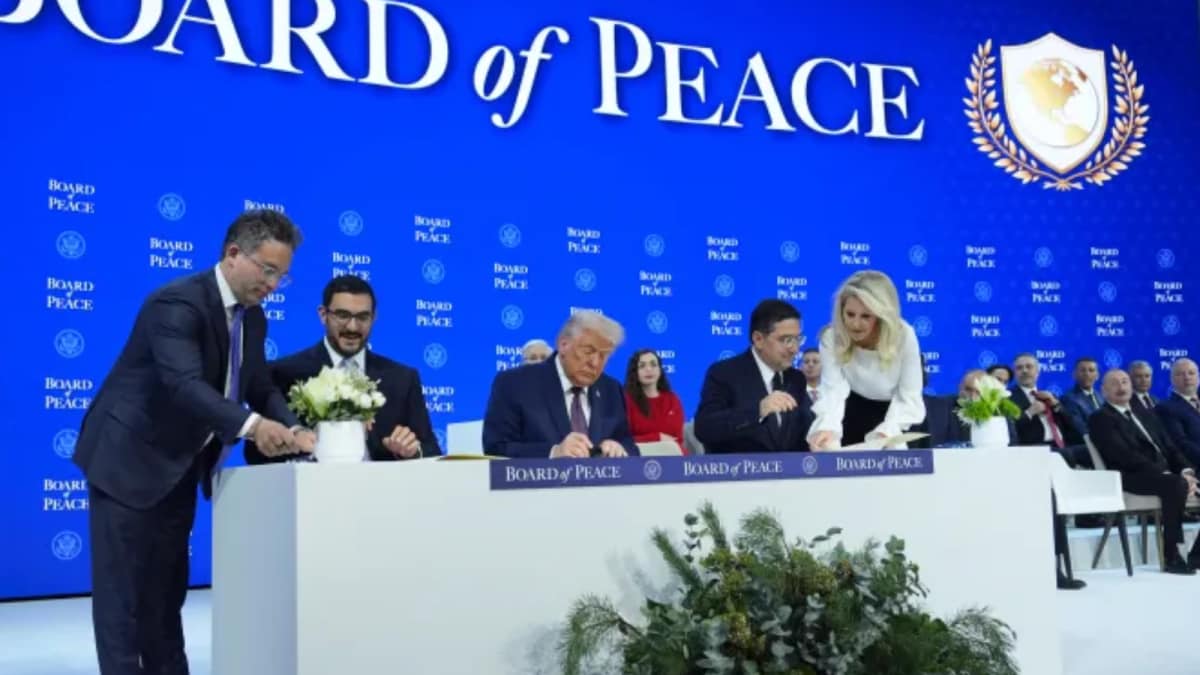
The Board of Peace is a new international body proposed by Trump last September as part of Phase 2 of his “20-Point Peace Plan." The initiative aims to address major conflicts — with an initial focus on Gaza — by overseeing reconstruction, humanitarian stabilisation, regional diplomacy, and investment mobilisation. 60 countries have been invited to participate. The Executive Board would manage portfolios linked to governance, reconstruction, regional relations and long-term financing.
Countries contributing $1 billion would receive permanent seats on the board; those that do not contribute would be eligible for three-year terms.
RT reported that while Putin thanked Trump for the invitation but said that more time would be needed to study the offer and consult Russia’s strategic partners. This comes after Trump on Monday (local time) confirmed that Russian President Vladimir Putin has been invited to join the proposed Gaza Board of Peace, describing him as one of several world leaders considered for the initiative.
First Published:
January 22, 2026, 14:00 IST
News explainers Putin Offers Frozen Russian Assets To Join Trump's Board Of Peace: What Are These Worth?
Disclaimer: Comments reflect users’ views, not News18’s. Please keep discussions respectful and constructive. Abusive, defamatory, or illegal comments will be removed. News18 may disable any comment at its discretion. By posting, you agree to our Terms of Use and Privacy Policy.
Read More





 English (US) ·