
 10 months ago
18
10 months ago
18
ARTICLE AD BOX
Last Updated:June 12, 2025, 14:23 IST
ESA-NASA’s Solar Orbiter reveals the Sun’s South Pole for the first time, uncovering the star's magnetic chaos and opening a new era in space science

NASA-ESA's Solar Orbiter took a historic photo the first clear picture of the Sun's South Pole on March 23, 2025 with an ultraviolet camera, (Credit: ESA & NASA/Solar Orbiter/EUI Team, D. Berghmans)
In a landmark achievement for solar observation, the European Space Agency (ESA) and NASA have unveiled the first-ever images of the Sun’s South Pole, captured by the joint Solar Orbiter mission. Released on June 11, 2025, these high-resolution images offer an extraordinary new perspective on our closest star.
A Unique Orbital Path
Previous missions such as SOHO and the Solar Dynamics Observatory (SDO) have only viewed the Sun from the plane in which Earth and other planets orbit. However, the Solar Orbiter broke new ground by reaching an angle of 17 degrees above the solar plane, capturing the South Pole in unprecedented detail on March 23, 2025.
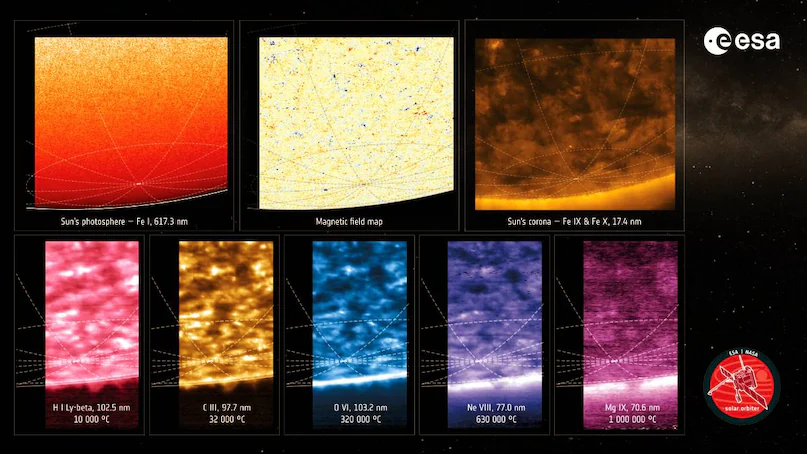
The Extreme Ultraviolet Imager (EUI) recorded views of the corona, that is, the Sun’s superheated outer layer reaching temperatures of one million degrees Celsius.
🌞 See the Sun from a whole new angle.For the first time, our Solar Orbiter mission has captured close-up images of the Sun’s mysterious poles, regions long hidden from our view.
In 2025, Solar Orbiter gave us a first-ever look at the Sun’s south pole.
Remarkably, it… pic.twitter.com/EhyYxtDyaR
— European Space Agency (@esa) June 11, 2025
Surprising Discoveries At The Solar South Pole
Among the most striking revelations is a region of magnetic chaos at the Sun’s South Pole, where north and south magnetic fields intertwine. This phenomenon occurs as the Sun undergoes a magnetic field reversal approximately every 11 years, triggering heightened solar activity including sunspots, solar flares, and coronal mass ejections.
Professor Carol Mandel, ESA’s Director of Science, heralded the discovery as “humanity’s first glimpse into the Sun’s deepest mysteries."
Mission Breakthrough And Future Prospects
Launched in 2020 at a cost of $1.3 billion, the Solar Orbiter reached a viewing angle of 15 degrees below the solar equator by March 2025, an achievement unattainable from Earth. By 2029, the spacecraft is expected to achieve a 33-degree inclination, promising even more comprehensive polar observations.
Professor Sami Solanki of the Max Planck Institute for Solar System Research confirmed that the findings align closely with existing computer models of the Sun’s magnetic field.
The Sun’s Magnetic Dance
Unlike Earth, the Sun is a plasma sphere with varying rotation speeds; its equator rotates every 26 days, while the poles rotate roughly every 33 days. This differential rotation causes the magnetic field to contort, eventually flipping the Sun’s magnetic poles.
Professor Lucy Green of University College London, who has been part of the mission since 2005, explained that the Sun’s magnetic field governs its activity cycles. A solar minimum, when magnetic activity is at its lowest, is predicted within the next five to six years. Scientists hope that data from Solar Orbiter will improve forecasting of such phenomena.
Overcoming Past Limitations
Although NASA’s Ulysses probe passed over the solar poles in the 1990s, it lacked imaging capability. The Solar Orbiter is the first mission to provide both magnetic data and visual imagery, revolutionising solar science and offering critical insights into space weather that can affect Earth.
- Location :
Paris, France
- First Published:
News world Sun’s South Pole Captured For The First Time In Historic Mission | Watch




 English (US) ·